


National Lottery Heritage Fund Archiving and Ancestry Blog
September 2025
So, this is where my journey into my archiving project at Ford Green Hall began, in the few months of starting volunteering at the Hall, in mid–2023. I had just finished my first year of a master’s in history, at Keele (after nearly twenty years away from academic study), with a focus on the early modern period – specifically the middle of the 1600s, and the English Civil Wars and Revolution. I had come to the Hall to volunteer, as I was – and continue to be – interested in pursuing work in the world of heritage. I also had the additional agenda of what I was going to make my dissertation subject about.
After only a brief time of volunteering at the Hall, I realised that there was a wealth of historical records, artefacts and other documentation housed at the Hall, which remained largely untapped, or which had become displaced over time. The museum’s small cadre of staff, and dedicated volunteers, were devoted to the task of the day-to-day running of the hall, preparing events and doing their utmost to keep the museum going, which did not leave much time to deal with I realised that there was both an opportunity, and an exciting mission, to explore through these records and to start the process of identifying and then categorizing this trove.
In times past it was evident that someone had made efforts to organise these records, alongside the collections of event photographs. However, the inevitable effects of time and entropy had taken its toll and undone this work, and much of the collection had subsequently become jumbled and misfiled. Therefore, I saw my first task was to gather these records, which in and of itself would prove to be a grand task, and then to begin to document and catalogue what I found. There was no attempt at this stage to reorganise, as the task felt more like an archaeological excavation, wherein I would identify what was found in situ (it would be – and still is – the mammoth quest to then properly organise everything into collections).
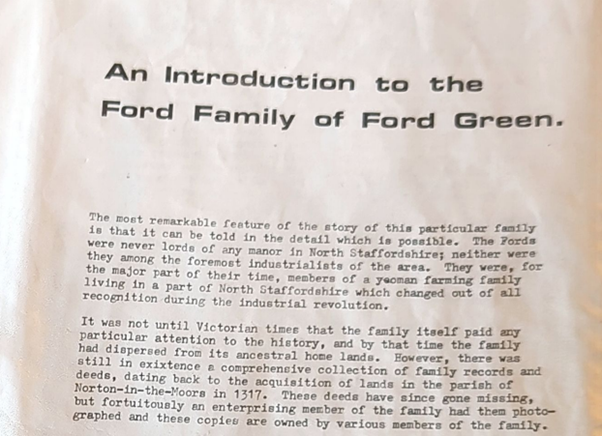
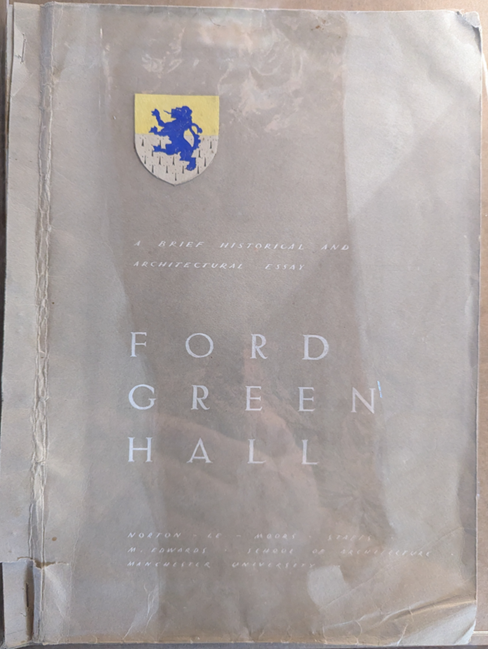
What I could accomplished on the days when I was volunteering was limited, as this came alongside aiding in the day-to-day running of the Hall. Thus, for many months, the file boxes full of photographs, aging magazine articles, and every so often an original document, were sifted through, identified, and added to a rudimentary Excel sheet of my own construction. Whilst the small collection of 17th century and later original documents are on display at the hall (or which had been already boxed and recorded in their own right), some documents had become lost to time, only to be recovered in my archaeological efforts. One example was the ‘A Brief Historical and Architectural Essay: Ford Green Hall’ by an M. Edwards, Manchester University, written in 1955, and evidently donated subsequently to the Hall. Time had not been kind to the cover, though the handwritten essay within, with its associated architectural drawings had survived well. M. Edwards’ work now is on display, with a scanned copy for visitors to peruse.
October 2025
The picture below is the accumulated documents, maps, photographs and other materials gathered together in preparation for the next stage in trying to begin assembling these into what will become a modest but workable archive, which will not only to serve the Hall in future events and displays, but also hopefully a useful and interesting source for visitors, the local community and potentially researchers.
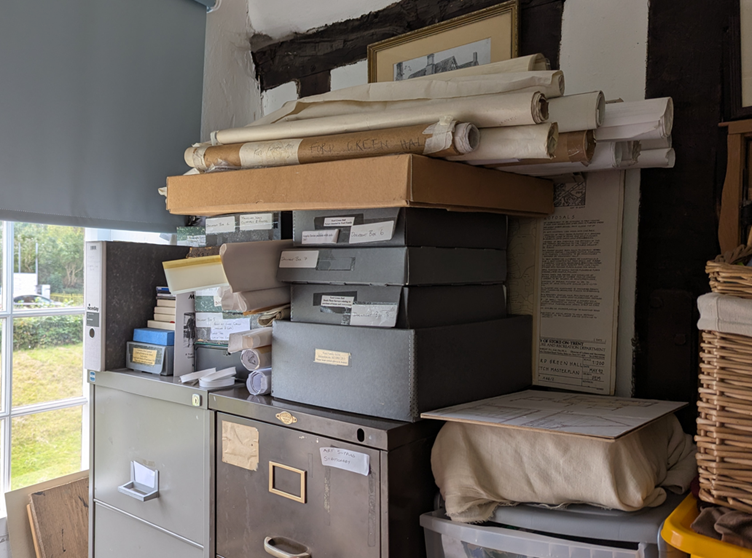
It is not a pretty sight, and I’m sure its jumbled appearance would make a professional archivist twitch nervously, however rest assured that there is some order to this madness, and this far from its final form. The resources at the Hall are limited, however, our intention is to begin indexing and housing the documents in the filing cabinets below. Whilst it may never look something like this:
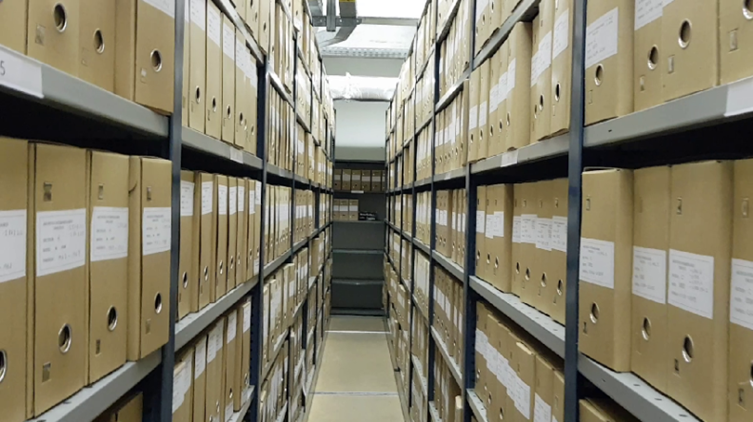
Nevertheless, our hope is that the Hall’s little archive will possess qualities akin to a professional archive. Furthermore, that it will both endure and contribute to the greater archiving world, as it is our intention to build relations with Stoke and Staffordshire Archives, and we are in the process of organising training with Stoke Archives to develop our skills and learn more of the art to archiving.
November 2025
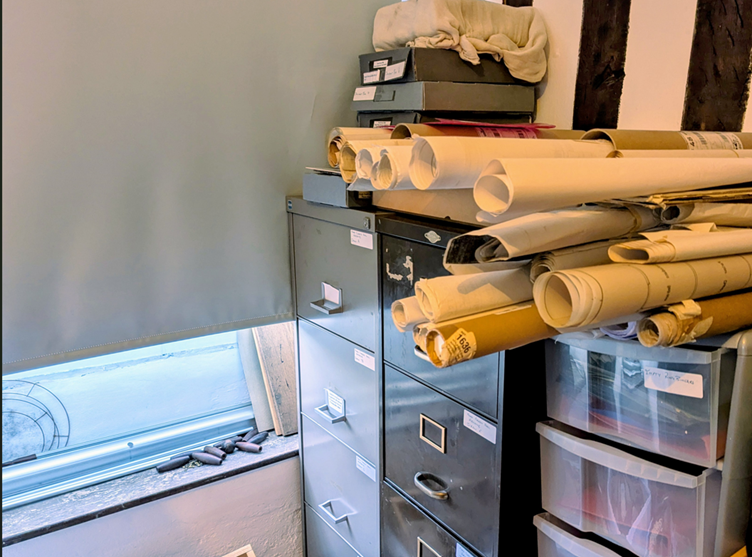
So, we’re making progress with the archive, it is still decidedly primitive, but we are making the best of what we can with the resources we have available. The main problems we have are to the storage of the large oversized rolled documents, we’re looking at some cost-effective solutions, which will protect the documents, and maintain a persistent order. Charlotte, who volunteers for the hall, (and put her hand up to join the project) had initially been interested in working through the reams of photographs held by the hall. However, on encountering the collection of these oversized documents, she decided on a change of tack and wanted to dedicate her time to working through ramshackle bundle of rolled up documents to uncover what might be found…
As for myself, I’ve been working through the donated documents and pressing on with rehabilitating the filing cabinets in preparation to make them a home for the archive. This is still an intermediate step, as the ultimate plan will be to properly categorise and house everything in a searchable, and persistent archive. Ideally, we want to use an established archiving system to do this – that’s within our means to afford.
December 2025
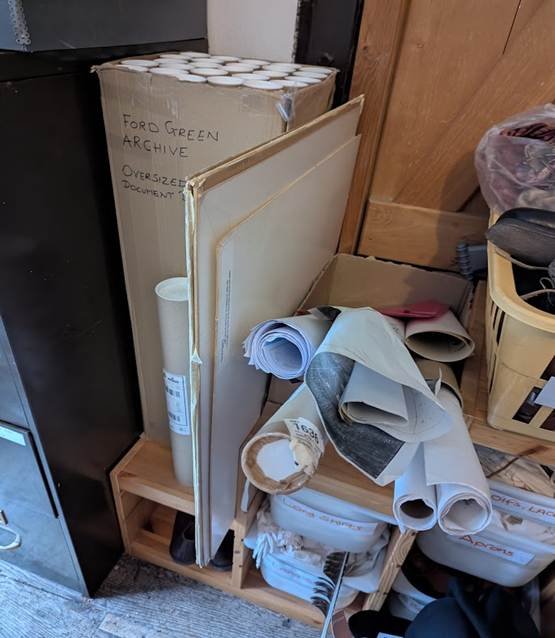
We’ve settled on a short-term solution for the storage of our oversized documents, as the current situation presented a problem to both the preservation and to keeping them in order (as they were prone to rolling off). Our solution is this: a box of poster tubes, which will help protect the documents, and keep them ordered and tidy, until we can settle on a more elegant and long-term solution.
With the approach of Christmas, and the Wind in the Willows event taking place at the Hall, progress with the Archive inevitably winds down, but with thoughts to progress the project in the new year. The aim will be to put together a display project hosted at the hall to draw interest from visitors both to the archiving project and to the ancestry project. Tasked as we are under the Heritage Fund with two objectives: firstly, providing a series of three sessions on ancestry research to the public, this requires several things, first and foremost is a group of interested members of the public, who will want to attend the training (and hopefully becomes a long term community group tied to the Hall). Secondly, preparation and writing for the sessions. We have two volunteers, Elaine and Mark, who have done their own extensive ancestry research, who have agreed to lead the sessions. So, I will be organising time with them to plan out the presentations for the three sessions. We have training with the Stoke Archives in January on ancestry research, and the hope is that this will be a springboard to the next stage.
Secondly, we have the more open-ended task of creating the archive, whilst this is making progress currently, we need a project to both focus our progress, and to promote public interest in our archive. There has been contact from Keele University about the possibility of a student placement, so we can hopefully incorporate this into the project. The Hall has a new website in development, and the hope will be that this blog can find a home there, and we can look at ways to promote the archive onto the website.
January 2026
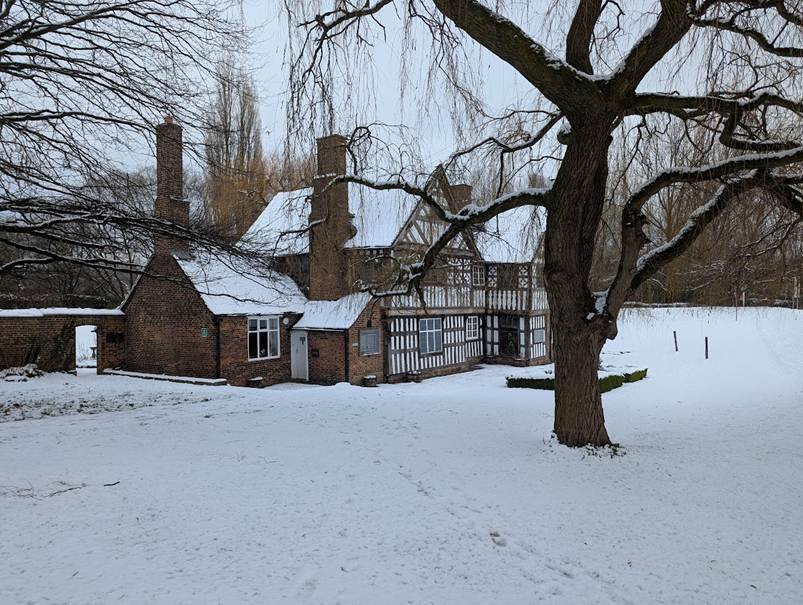
We are now looking at an event to highlight the work we have done with the archive, a presentation at the Hall for visitors to explore. We are looking through what we have to form a basis for this, currently the most fruitful possibility is the archaeological work that was done at the Hall between August 1995 and July 1997, as we have pre-published copies of the archaeological report in the archives (though some additional research has located a copy of the published report by Noel Bothroyd, who directed the 1996 and 1997 excavations). Fortunately, the organising of the records at the Hall have also located mounted photographs and other illustrative materials from the digs, which we can use as part of the display. It is the task now to read through the report to see what was discovered and what we can highlight to visitors when they explore the Hall and grounds. We also have maps of the digs and can identify where the various trenches were put in and identify where various structures were installed.
The conclusions from the excavations were encouraging, specifically how the well-recorded history of the hall, and its occupants both before and after 1803, helped the archaeologists make findings in respect to the consumption of ceramics.[1] Due to the known pattern of residency at the Hall, it was possible to make inferences normally unavailable at many other sites – where the archaeologists would have to make judgments concerning the status of the occupiers from the findings alone. However, at Ford Green Hall, armed with the established record of occupation, they were able to ‘address a wide variety of questions’[2] about the attitudes of households towards ceramics within a direct proximity to the Potteries.
In his conclusion Noel Boothroyd made the following observations about the Ford Green Hall site:
‘Archaeology has confirmed the continuous development of the site from the medieval period, a development which mirrors national trends, e.g. the great rebuilding of the late 16th/early 17th centuries, brick building of the early 18th century, and the impact of urbanisation and mass production following the industrial revolution in the 19th century. It also allows a glimpse into the personal lives of the inhabitants of Ford Green Hall through their material culture.’
February 2026
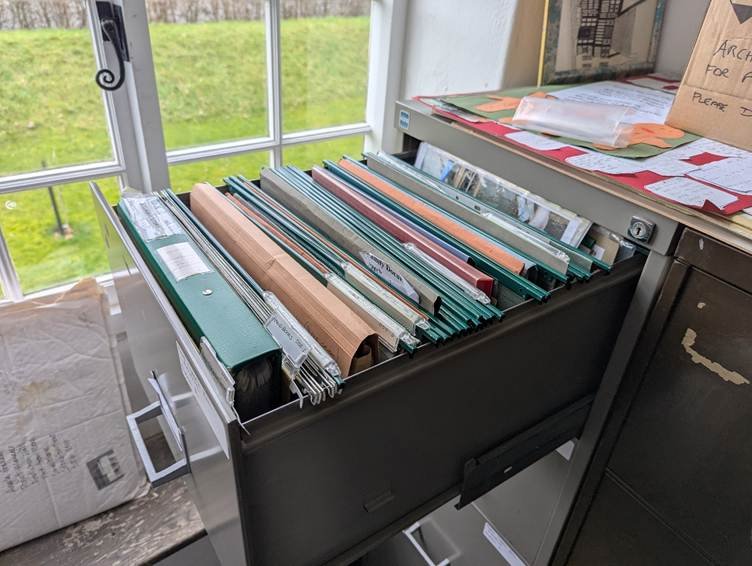
February is coming to a close with some good progress, but also some sad news. Firstly, the sad news (and congratulations), from early April we will be losing Charlotte as a regular volunteer – as she has successfully secured full time work at the V&A Wedgewood museum in Barlaston. We wish her well, and hope that we will still see her at the hall for future events. This is an unfortunate setback for the project however, as Charlotte’s work with our archive project, identifying and collating the various large documents, has been invaluable. We will be on the lookout for volunteers to step up to help, including the possibility of recruiting our two Keele students, here on placement – should they be interested…
The picture above may not look like much, but it is the first real step in the next stage with the archive. Having located and collected together most of the records held at the hall (I am confident that there are many more documents of value to our little archive, which have been filed away in all manner of odd nooks and crannies about the hall, and as such remain undiscovered) it has been possible to begin the task of trying to rationalise what we have in to a more coherent and accessible collection. The draw you see above is designated for primary sources, academic work and research which has been performed at or related to the hall. The second draw is beginning to host the photographic collection for the hall, with photographs dating back to the 1940s and 1950s (though the bulk is from the 1990s and 2000s). This will be a long and ongoing project, and almost certainly subject to change, as it progresses. We have also introduced an indexing system – one which I’m sure would make a professional archivist go grey in horror and make Melvil Dewey[4] revolve in his grave. However, if we slavishly devoted ourselves to the Dewey decimal system, then we’d have to start from 900 (history), with a heavy dose of 940 (European history) and a pinch of 910 and 920 (geography and biography & genealogy respectively) and then jump back to 700 for photography, with nothing in any other class. Instead, well at least for now, we’ll progress with an inhouse classification system, starting with 000.
In other news, the ancestry training we had booked with Stoke Archives was postponed by Stoke Archives, we are hoping to get a replacement session booked as soon as we can, but this unfortunately will continue to stall the ancestry side of the project. However, with the new website due to go online at the end of February we will be able to start publicising on there for interest from the local area for people interested in receiving training on how to do ancestry research. Once we have the training in hand, and we can progress to building the training sessions, and hopefully initiate the beginnings of a new community group using the hall.